
Home Networking / Wi-Fi Planning / 7 min read
Why a Wired Backbone Beats Wireless Mesh in Concrete-Block Florida Homes
Florida concrete-block homes with metal roofs and stucco exteriors block Wi-Fi more than wood-frame houses, so a wired backbone usually beats wireless mesh hops.

Short answer
Florida concrete-block homes with metal roofs and stucco exteriors block Wi-Fi more than wood-frame houses, so a wired backbone to planned access points usually beats relying on wireless mesh hops across the house.
01
Concrete block, stucco, and metal roofing absorb and reflect Wi-Fi more than wood framing.
02
Wireless mesh hops lose speed at every wall; wired access points keep a clean path back to the switch.
03
A floor-plan review spots the dead zones before hardware is bought.
Florida Construction
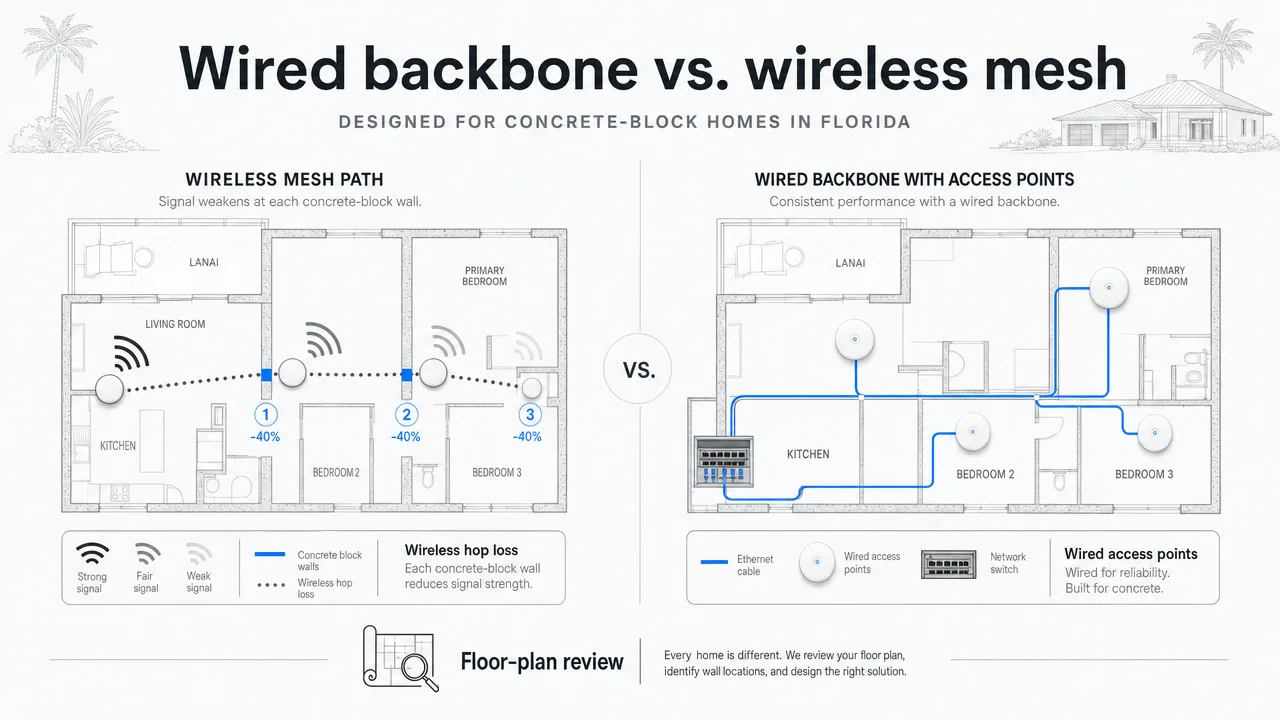
Wired backbone vs wireless mesh in concrete-block homes
Concrete block, stucco, and metal roofing eat wireless hops. A wired backbone gives each access point a clean path back to the switch.
- Concrete block walls
- Stucco and metal roof
- Wireless hop loss
- Wired access points
- Floor-plan review
Florida Construction
Concrete block changes the Wi-Fi math
Many Emerald Coast homes are built with concrete block, stucco, and sometimes metal roofing. Those materials are great for storms and durability, but they absorb and reflect Wi-Fi far more than wood framing.
A signal that crosses a wood wall easily can lose most of its strength crossing a concrete-block wall. That is why the same mesh setup that works in a wood-frame house often struggles in a Florida home.
Wireless mesh loses something at every hop
A mesh node depends on a wireless link back to the rest of the network. In a concrete-block home, each wall between nodes eats part of that link, and the loss compounds across hops.
Wired access points avoid the problem. The path back to the switch is a cable, not a guess through several walls.
Plan from the floor plan, not from the app
The app tells you coverage is weak after you already live with it. A floor-plan review identifies the dense walls, the long hallways, the garage, and the detached spaces before hardware is purchased.
That is where a wired backbone earns its keep: it turns a guessing game into a planned system.
FAQ
Common homeowner questions.
Is mesh bad for Florida homes?
Not always, but concrete block and metal roofing make wireless mesh hops less reliable. Wired access points are usually a better fit for large Florida homes.
Why does my Wi-Fi drop between rooms?
Concrete-block, stucco, and metal roofing absorb and reflect Wi-Fi. A wired access point plan addresses this at the source instead of adding more mesh pucks.
Can I keep mesh and just add wired backhaul?
Sometimes, but if you are already running cables, UniFi wired access points usually give cleaner switching, camera, and management options.
Tech Techr LLC
Need a floor-plan review before hardware is purchased?
Tech Techr designs, configures, documents, supports, and coordinates UniFi Wi-Fi and camera technology packages for homes across Freeport, Hammock Bay, and the Emerald Coast.
Schedule a home network consult